Tuesday, May 14, 2013

May 13, 2013 – Class #1 at Sinai Temple – Saran Wrap Method

DeAnn demonstrated the saran wrap background technique today.


Materials needed:
8 ½ x 11 sheets of Arches Text Wove
Saran Wrap or similar plastic wrap (whatever you use at home)
Watercolors, gouache, colored ink, including metallic; acrylic inks also OK
Large brush, at least 1-inch, or sponge brush. Doesn’t have to be a good brush, painter’s brush (e.g. synthetic wash brush http://www.dickblick.com/items/06263-1001/ or flat brush http://www.dickblick.com/items/05158-1001/)
2 water containers (for clean/dirty water)
Spray bottle
Extra paper for more practice – should be cover weight absorbent paper with some texture for best results. (Sundance paper from Kelly Paper works well)

Setting up your workspace to work with watercolors:  Have 2 containers of water – one is for dirty, one is for clean. When changing colors, you’ll be rinsing your brush first in the “dirty” container, then in the “clean” water to ensure no color contamination. Change the water as needed when it gets too dirty. Add a few drops of water to the watercolor pans you’ll be using to hydrate them. Use the lids of the watercolor set as your palette. Soften the pan with a couple drops of water, then put the colors you want to use in a clean palette space and add drops of water to thin the watercolor to an ink consistency.


Paint on wet medium:  watercolor will flow wherever it’s wet on the paper and stop when it encounters dry paper. Creating a saran wrap background on wet paper will be subtly different from painting on dry paper, mostly in the edges. First, spray both sides of the paper with the spray bottle. This relaxes the paper and prevents it from curling. Make sure the whole sheet is evenly wet.

Start painting with your first color – notice that the watercolor will spread on its own since the paper is already wet. Use lots of water and paint where you want.


If you want, add a second color in a different location. You can blend them if you want, or just paint near each other. Add more colors if desired. Spritz the paper with the spray bottle if it’s drying.


Once you’re satisfied with the colors, take a piece of plastic wrap (it should be larger than the page) and place it on top of your watercolored paper. You want some wrinkles in it, so if it’s flattened against the wet paper, smoosh the plastic wrap toward the center or lift it up and crinkle it slightly as you lay it back down.


If the watercolor isn’t moving, you don’t have enough water. Spritz with the spray bottle, or drop some water in strategic places. Lift the page and hold it up vertically so that the watercolor flows in the wrinkles of the plastic wrap.


Change directions so the colors blend and watercolor flows in different directions. Put aside to dry on newspaper so it’ll soak up any excess moisture. Once it’s dry, peel off the plastic wrap and you should see a crystallized look.

Paint on dry medium:  You can also do the saran wrap method without wetting the paper beforehand. Using a lot of water, paint as desired on the dry paper. Notice how the watercolor will pool and not spread across the page. Don’t paint all the way to the edges.


Once you’re satisfied with your watercolor placement, put a piece of plastic wrap on top of the page. Make sure your watercolor is wet enough to move.


Once again, hold up the page in different directions so that the watercolor will spread through the crinkles in the plastic wrap. Notice how it’ll travel across the wet-dry boundary along the wrinkles.

Wednesday, May 8, 2013

Calligraphic Techniques Class at Sinai Temple starting 5/13/13


We will be doing some very fun and useful techniques for backgrounds of calligraphy.

In this 6-week course, students will learn 5 different calligraphic background techniques during the first 5 weeks. The 8 1/2 x 11 pages will be folded in half and the instructions for that particular technique are written in the student’s choice of calligraphic hand. Then in the last class, these pages will be bound into a book.

In addition to these techniques if you want to work on COPPERPLATE we will work on that also.


The following are materials you’ll need for the first class. We’ll be cutting the papers to use for both the different techniques and for the book covers. These papers will be available for sale at the first class.

Materials students should bring every week (in addition to their usual basic calligraphy tools):
* X-acto knife with #11 blade (like the one we use in class http://www.dickblick.com/products/x-acto-gripster-knife/) or snap-off blade craft knife (e.g. http://www.dickblick.com/products/alvin-break-off-blade-knives/)
* Cutting mat (e.g. http://www.dickblick.com/products/alvin-cutting-mats/)
* Metal ruler, at least 24” long  (e.g. http://www.dickblick.com/products/c-thru-flexible-stainless-steel-rulers/)
* Bone folder  (e.g. http://www.dickblick.com/products/lineco-bone-paper-folders-and-scorer/)
* Extra paper for more practice – should be cover weight absorbent paper with some texture (for best results)
* Dappen dish is a small container to put ink in. (optional) (e.g. http://www.paperinkarts.com/dappen-clr.html)

click on photo to enlarge

We'll also learn the saran wrap method the first week. The materials needed for the first class are:

* Saran Wrap or similar plastic wrap (whatever you use at home)
* Watercolors, gouache, colored ink, including metallic; acrylic inks also OK
* Large brush, at least 1-inch, or sponge brush. Doesn’t have to be a good brush, painter’s brush (e.g. synthetic wash brush http://www.dickblick.com/items/06263-1001/ or flat brush http://www.dickblick.com/items/05158-1001/)
* 2 water containers (clean/dirty)
* Spray bottle
* Newspaper (to lay out papers to dry)
* Extra paper for more practice – should be cover weight absorbent paper with some texture for best results. (Sundance paper from Kelly Paper works well)

Tuesday, April 23, 2013

April 15, 2013 - Last Italic class at Sinai Temple

DeAnn passed out 3 more guideline sheets for Italic:  x-height = ¼” using the 1.5 mm nib; x-height = 3/16” for the 1 mm nib; guidelines for the ¾ mm nib to use with the 1mm nib when addressing envelopes or writing placecards.

Student’s finished and in-progress Illuminated Manuscript projects. (click on image to see it at a larger size)

Judith's Can Can piece

Judith's Calder piece

Trini's piece
Barbara's piece

Linnea's piece

Caroline's piece (Uncial)


Saturday, March 16, 2013

Fire Devastation!!!!

My son's family barely escaped with their lives when a quick moving electrical fire burned their rental house to the ground. My son, Donavan,  his wife Jennifer, their sons, Nathan (8) and Mason (4) ran through the back door to escape the flames. They are all safe but everything they own including both cars were destroyed. Their cousin, Kapeela and Jose Diaz have taken them into their home for now and have been helping them sift through the rubble for anything that can be salvaged. We are so grateful that they are safe. Both Donavan and Jennifer are life-long soldiers and just moved to Honolulu in January for a change of orders. Donavan has served for 18 years and deployed twice to Iraq and scheduled to go to Afghanistan, Jennifer deployed once to Iraq attached to a MASH unit. Because they've only just moved into this house they hadn't purchased renters insurance yet, so the contents of the house are not covered. This is where my daughter, Hailey, and I have decided to mount a fundraiser to help them out. If you feel inclined to give them a hand it would be very appreciated! Even a small amount would help.

April 20, 2013 We have raised a wonderful amount of money for the kids, and we'd like to thank you all for your generous contributions!!!!! 1000 Thanks!

From Hawaii News Now:

Click to read
Find related story here:  Family escapes unharmed as fire rips through Foster Village home

Read more.


Sunday, March 10, 2013

February 25, 2013 - Class #5 at Sinai Temple

DeAnn demonstrated writing with the Brause 2.5mm chisel point nib at a 5-degree slant. She went over issues seen in the homework.


Homework review:
If you encounter drag on the upstroke when writing with the 5mm nib on the blue grid paper, try switching to the black grid paper. It seems to have a smoother surface and also bleeds less.
Be aware of your pen angle; if it’s too flat (i.e. less that 45-degrees), then the down-strokes will be thicker and the letters will look heavier on the page. Before you start a stroke, make sure your nib goes from corner-to-corner at a 45-degree angle.
The correct pen angle for Italic

Use heavier pressure on the down-stroke, lighter pressure on the up-stroke. Keep the nib flat on the paper.
The x-height (space from waist to base) for the 5mm nib is 1-inch. The x-height for the 2.5 mm nib is ½ inch (or 4 boxes on the 8x8 grid paper). Remember to line the paper correctly so that the letters will be the correct height.
Lining the grid paper for the 5 mm nib; x-height = 1 inch (step 1)

Lining the grid paper:  For the 5 mm nib, the black grid paper already has darker lines 1-inch apart. Label the lines as ascender, waist, base, descender, or put an “x” on the line to write on.

If you’re using the blue grid paper, line the paper at 1-inch intervals with a pencil so that it’s clear where the waist and base lines are. Using the 18” C-thru ruler easily creates a 2-inch margin on each side of the 17x22 sheet. By placing it in the middle, you don’t have to move it back & forth, just downward as you draw the lines with a sharp pencil, preferably with 2H lead. The grid of the ruler matches the grid paper (on the 1-inch = 8 boxes side of the double-sided grip paper, the Beinfang paper with the blue lines is the same-size grid on both sides). Match the appropriate line of the ruler to the grid and make the 1-inch lines darker.

For 2.5 mm nib, the x-height is ½-inch, so you need to draw lines between the darker lines on the 8x8 grid paper. Because pencil is hard to see against the black lines, use a colored thin marker or sharp color pencil.
Lining the paper for the 2.5 mm nib; x-height = 1/2 inch (step 2)

Accuracy is more important than speed. If using a pencil, twirl it slightly as you line so that it stays sharp. Hold the ruler with your left hand and with your right hand, draw the line from left to right.

If the 17x22 paper is too large and unwieldy to write on at the ½-inch x-height, tear it in half and then line it.

Drawing the slant lines:
The typical slant for Italic is 3 – 15 degrees. We’re going to use 5-degrees. You can use a protractor to make the first slant line. Then use the 18” c-thru ruler to make parallel lines ½-inch or 1-inch apart for the rest of the page.

Shortcut to make the 5-degree slant without a protractor:  Make 2 dots 11-inches apart vertically. Then make a 3rd dot 1-inch away horizontally from the top dot. Connect the bottom dot and the 3rd dot and you’ll have a 5-degree slant line.

grid paper lined for the 2.5 mm nib with slant lines of 5-degrees
Writing with a slant:  Keep the pen angle at 45-degrees, but instead of following the vertical grid lines, write against the slant lines. The downstrokes should be parallel with the slant lines. Your eye bounces back and forth between the slant line and the stroke you’re making to make them parallel. Look at the previous letter and try to make the next letter parallel to that one.

The exit serif (see Italic minuscule handout) should go in the direct of the pen angle to make a “hairline serif.” It’s not a flick; follow through the stroke on the paper.
radius of exit serif should be small. the one on the "i" is too big.
entrance serifs, picket-fence spacing, exit serifs


This is step 3. Step 1 is writing with the 5 mm nib at 90-degrees (i.e. no slant). Step 2 is writing with the 2.5 mm nib at 90-degrees. Step 3 is writing with the 2.5 mm nib with a 5-degree slant.

HOMEWORK:  Write alphabet sentences or other text with the 2.5 mm nib at a 5-degree slant. Remember to line the paper accurately. It might seem tedious, but it’s important to have the paper lined correctly.

Monday, February 25, 2013

February 11, 2013 - Class #4 at Sinai Temple

DeAnn demonstrated writing with the Brause 5mm chisel point nib. She explained pen angle and how it affects the thickness of the strokes.

Satomi's Italic monoline homework

Italic with the chisel point nib:  To start, we’ll be using the Brause 5mm nib (largest one). If you have the Brause holder that’s flat on one side, insert it toward the right side (when holding it) of the wooden nib holder. If you’re looking at the holder head-on, the nib will be toward the left edge.

Pen angle:  The Brause is a chisel-point pen, able to create thicks & thins within one stroke, based on the angle of the pen. Using a protractor as the reference, a pen angle of 0-degrees equates to holding the pen so that the nib is parallel to the horizontal lines of the grid paper.  A vertical stroke at this pen angle is the thickest; a horizontal stroke is the thinnest. If the pen angle is 90-degrees, then a vertical stroke is the thinnest and a horizontal stroke is the thickest. For a 45-degree pen angle, use a box as a reference and place the pen so that you’re placing it on the diagonal of the box. At this angle, both a vertical stroke and a horizontal stroke should be the same thickness.


x-height: is the height between the waist and base. Each hand has a specific x-height measured in pen-widths. At a pen angle of 90-degrees, draw short horizontal strokes to measure by pen widths.


Italic has a pen angle of 45-degrees and an x-height of 5 pen widths, which equals 8 boxes or 1-inch on the 8x8 grid paper. The 5mm nib should fit one box corner-to-corner.
the 5mm Brause nib has an x-height of 1-inch

In class we practiced writing downstrokes & cross-strokes at 0 and 90 degrees, at an inch in height. Dip the pen so the reservoir is 3/4 full. Wipe the nib on the edge of the ink well to take off any excess. We need to get fully familiar with this chisel point nib. Practice making straight lines with the nib. You need even pressure on both sides of the nib. Not a lot of pressure, just even pressure. The ink will flow better to begin with if you give a little side-to-side "rub" (like an ice-skate) with the nib. Or touch the tip to some wet ink on a previous stroke. As you draw the stroke down the page, EXHALE. This helps give a more controlled stroke. Also, set your opposite hand near the work so you can give slight pressure as you start down. These tips will help you have success quicker. At this large size, ink will puddle at the end of the downstrokes; don’t worry about it now, it’s natural & expected.

Writing vertical strokes at a 45-degree pen angle:  set your nib corner-to-corner and don’t move until you achieve that angle. Watch the left side of your nib and pull straight down. Keep the angle steady and constant; don’t turn the pen holder in your fingers. The angle at the top of the stroke should be the same at the bottom; look at the triangle shapes – they should be the same.

The chisel point pen doesn’t push well, especially at the larger sizes like 5mm. So you can make a “pull” stroke at the end of the “b”, for example (similar to top of the “a”).

To achieve the thicks and thins with the chisel point nib, you must keep it at the same angle. Don’t turn the pen-holder in your fingers as you make a curved stroke.

When practicing the lowercase letters from Satomi’s exemplar, write a letter about 3 times, then move on. Compare your letter to the exemplar and really look at the shapes.


Satomi’s exemplar is the sans serif (i.e. “no serif) Italic lowercase. Once  you’re comfortable with writing the sans serif letters, try adding serifs to the letters. Because DeAnn recommends rubbing back and forth slightly to start, the letters already have a slight entrance serif. To add an exit serif, continue the downstroke instead of stopping and exit upward with a hairline. Don’t flick the stroke.


close-up of the exit serifs on t and h

Remember:  write with even pressure, not too hard. Then less pressure on the upstrokes.

Cleaning the Brause chisel point nib:  Usually, wiping off the nib is enough between practice sessions. But if it has become crusty with dried ink, then it should be rinsed in water. To remove the nib from the holder, hold the nib in a rag – the sharp metal of the nib can cut your finger – and pull it out of the holder. Still holding the nib in the rag, then pull the reservoir off of the nib. Don’t let the reservoir wash down the drain! Put it aside. Wash the nib under running water and dry it off. Use an old soft toothbrush if you need to scrub it some more.

Putting the nib back together:  Make sure the nib and reservoir are dry; then put the reservoir on your finger (flat side down). Place the nib into it and hold onto the reservoir with your thumb and first finger as you push the nib back in.

If you do lose a reservoir, the reservoir from any other Brause chisel point nib will fit.

Homework:  Practice the spacing words and alphabet sentences with the 5mm nib. Once you’re comfortable, go down to the 2.5 mm nib (it says “2 ½ mm” on the nib). The x-height will be 4 boxes or ½-inch. Be sure to line your paper with the proper x-height.

Tuesday, February 19, 2013

DeAnn teaching Copperplate at RAND


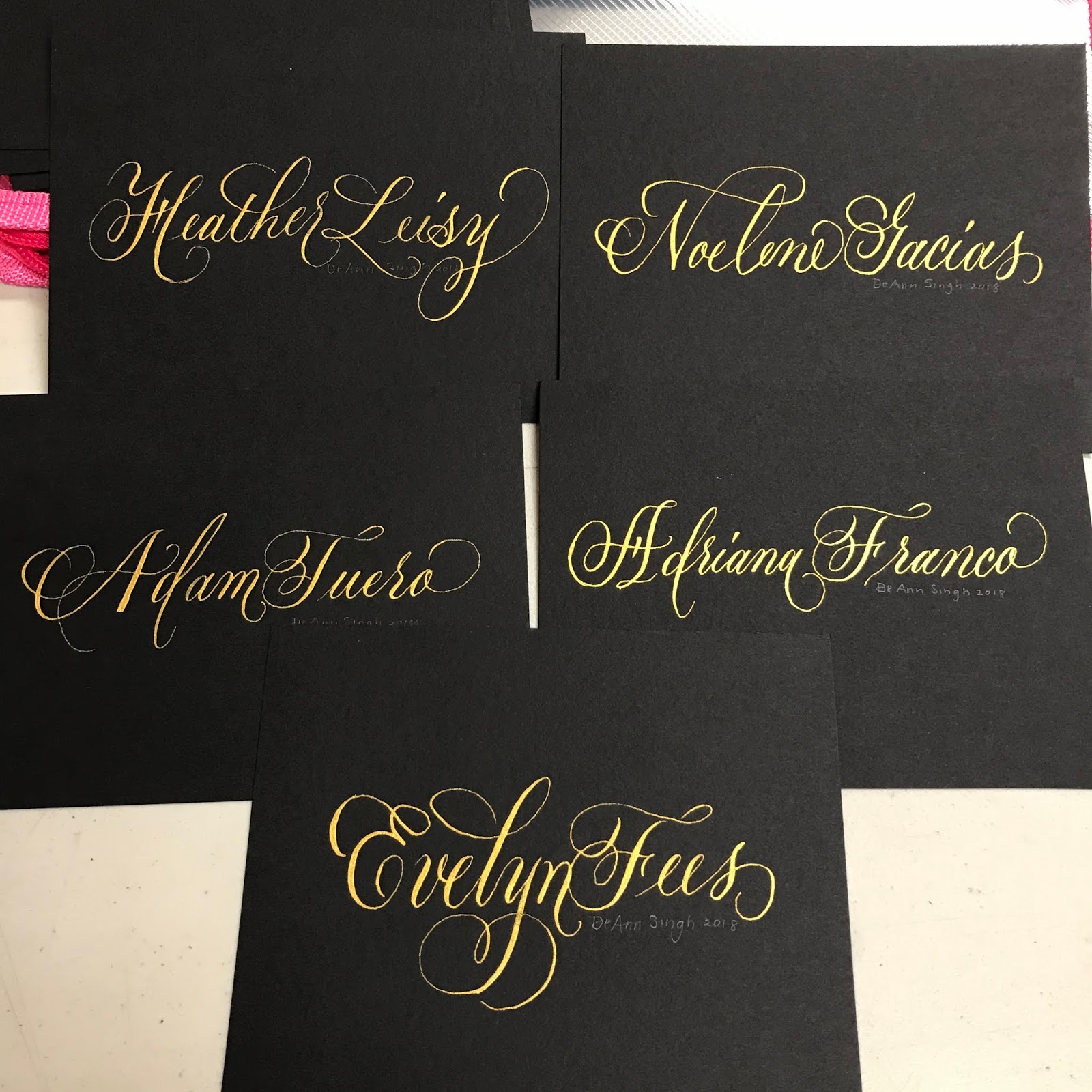
Learn the elegant and flowing 18th Century hand called Copperplate. This style of calligraphy will improve the rhythm of your writing in general and help spacing for italic. DeAnn considers this by far the most relaxing hand to write. We will learn lowercase and capitals and will learn flourishing which will apply to all calligraphic styles. This is a beautiful hand that is used extensively for invitations and envelopes. Materials can be purchased during the first class.

Copperplate -- All Levels
6 Thursday evening classes
Time: 5:30 to 7:30 pm
At the RAND Corporation
3/14, 3/21, 3/28, 4/4, 4/11, 4/18
Instructor:  DeAnn Singh
Cost:  $72

PLEASE NOTE:  Payment must be received no later than Thursday, March 7. A minimum of 10 students is needed in order to hold the class.

To Enroll:  Make check payable to Marian Oshiro and send to:

Marian Oshiro, M5N
RAND Corporation, 1776 Main Street
Santa Monica, CA  90407

FOR MORE INFORMATION: Send email to "shirleycromb@hotmail.com"
Or... "marian_oshiro@rand.org"